
eBooks
100 Books found- Featured
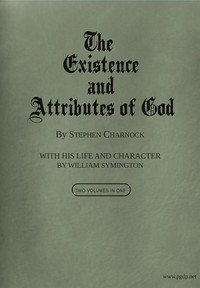
The Existence and Attributes of God, Volumes 1 and 2 by Stephen Charnock
Authors: Charnock, Stephen, 1628-1680
Hey, I just finished reading something that completely rewired my brain. It's called 'The Existence and Attributes of God' by Stephen Charnock. Don't let the old-school title fool you—this isn't some dry lecture. It's like a 17th-century detective story, but instead of solving a murder, Charnock is trying to solve the biggest question of all: Is there a God, and if so, what is He like? He doesn't just tell you to have faith. He builds a case, brick by logical brick, using the world around us as evidence. He looks at the stars, the complexity of life, the very fact that we're here having this thought, and asks, 'Could this really just be an accident?' It's a slow, deep, and sometimes challenging read, but if you've ever stared at the night sky and wondered 'What's the point of all this?', this book feels like having a brilliant, patient friend walk you through the most important investigation of your life.
- Featured
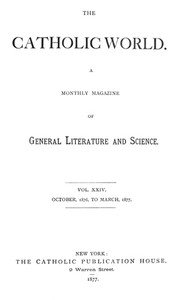
Catholic World, Vol. 24, October, 1876, to March, 1877 by Various
Authors: Various
Hey, I just finished this fascinating time capsule of a read! It's not your typical book – it's a bound collection of a Catholic magazine from 1876-1877. Think of it as a six-month window into what people were worried about, arguing over, and dreaming of in the late 19th century. The 'conflict' here isn't a single plot, but the massive cultural and intellectual shifts happening all at once. You have the Church navigating science, politics, and social change in real time. One minute you're reading a fiery defense of doctrine, the next a surprisingly detailed article on astronomy or a travelogue from the Holy Land. The mystery is figuring out what the world looked like through their eyes. It's a bit like historical eavesdropping, and it completely reshaped how I think about that era. If you're curious about how people actually thought back then, beyond the dry dates and events in history class, you need to pick this up.
- Featured
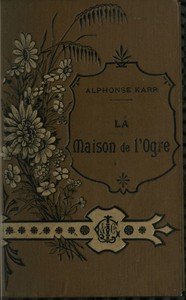
La Maison de l'Ogre by Alphonse Karr
Authors: Karr, Alphonse, 1808-1890
Ever wonder what secrets hide behind the doors of a house everyone in town avoids? Alphonse Karr's 'La Maison de l'Ogre' (The Ogre's House) is a short, sharp tale from 19th-century France that isn't about a literal monster. It's about the human monsters we create with our gossip and fear. The story centers on a grand, isolated house and its mysterious, reclusive owner. The whole village whispers about him, calling him an 'ogre' and spinning wild tales. But when a curious outsider arrives, determined to see the man for himself, he discovers the shocking truth. This isn't a fantasy; it's a brilliant, biting look at how quickly we judge others and the real damage done by rumors. It's a surprisingly modern story about isolation and perception, wrapped in a classic package. If you like character-driven stories that make you think, this hidden gem is for you.
- Featured

St. Bernard of Clairvaux's Life of St. Malachy of Armagh by Bernard
Authors: Bernard, of Clairvaux, Saint, 1091?-1153
Hey, have you ever wondered what a saint might say about another saint? I just finished this wild little book from the 12th century. It’s St. Bernard of Clairvaux—yes, the famous, fiery reformer monk—writing about his friend, St. Malachy, an Irish bishop who basically tried to drag the Irish church into the European mainstream. Bernard paints this vivid picture of a man caught between two worlds: the old, mystical, isolated Celtic Christianity and the new, organized, Roman version. The real mystery isn't whether Malachy performed miracles (Bernard says he did plenty), but whether his life's work—this massive cultural and religious overhaul—was a success or a heartbreaking loss of something ancient and unique. It’s a portrait of friendship, faith, and radical change, written with the intense admiration of someone who watched the whole struggle up close. It feels less like a dusty history and more like a heartfelt eulogy for a revolutionary.
- Featured
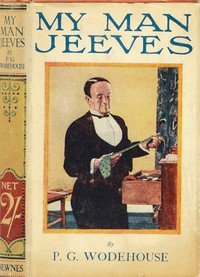
My man Jeeves by P. G. Wodehouse
Authors: Wodehouse, P. G. (Pelham Grenville), 1881-1975
Okay, picture this: you're a well-meaning but completely clueless young gentleman in 1920s London. Your life is a series of small disasters—a broken engagement, a terrible gambling habit, an aunt who wants to send you to the countryside. Enter Jeeves, your valet. He's a silent, towering pillar of intelligence who fixes your messes with a raised eyebrow and a perfectly timed 'Very good, sir.' 'My Man Jeeves' isn't about a big mystery; it's about the hilarious, ongoing conflict between Bertie Wooster's charming stupidity and Jeeves's infallible brain. Every story is a new scrape Bertie gets into, and the pure joy is watching Jeeves, with the calm of a chess master, maneuver everyone into a happy ending, usually while saving Bertie's skin and quietly getting rid of a truly awful item of clothing. It's the ultimate comfort read—smart, silly, and guaranteed to make you smile.
- Featured
The History of the Manners and Customs of Ancient Greece, Volume 3 (of 3)
Authors: St. John, James Augustus, 1795-1875
Okay, so you know all those Greek myths and legends about gods, heroes, and epic battles? This book is about what happened after the credits rolled. 'The History of the Manners and Customs of Ancient Greece, Volume 3' by James Augustus St. John is the final chapter in a massive project to show us how regular Greeks actually lived. Forget just the politics and wars; this is about the real conflict: how do you build a society from the ground up? It tackles the everyday mysteries. How did they raise their kids? What did a typical family argue about over dinner? What games did they play, and what did they truly believe in when no one was writing it down for the history books? St. John acts like a detective, piecing together clues from art, pottery, fragments of lost writings, and archaeology to reconstruct a world that's often overshadowed by its own mythology. This volume wraps it all up, focusing on the private life—the home, education, women's roles, and religious practices that were the glue holding everything together. It’s a deep dive into the human side of a civilization we only think we know.
- Featured

Les bijoux indiscrets by Denis Diderot
Authors: Diderot, Denis, 1713-1784
Okay, picture this: you're in a glittering, fictional kingdom where the Sultan is bored out of his mind. To spice things up, he gets a magic ring from a genie. But this isn't a ring for invisibility or treasure—it makes women's private jewelry *talk*. Yes, you read that right. Their earrings, necklaces, and other adornments start spilling their owners' deepest, most scandalous secrets. What starts as a royal party trick quickly spirals into chaos as the entire court's hidden lives are exposed. It's a wild, funny, and surprisingly sharp satire about gossip, power, and the things we try to hide. Think of it as an 18th-century gossip blog, but with way more silks and genies.
- Featured

Spalding's Baseball Guide and Official League Book for 1889 by Henry Chadwick
Authors:
Okay, hear me out. I know a 130-year-old baseball rulebook sounds like the world's driest read, but trust me, this thing is a time machine. It's not really a story—it's a snapshot. The 'mystery' here is figuring out what baseball even was back then. The pitcher's box was only 50 feet from home plate? Batters could ask for a high or low pitch? Games were called on account of darkness? This book lays it all out, straight from the source. Reading it feels like you've discovered the original blueprint for America's pastime, written in a time when it was still being invented. If you've ever wondered how the game became what it is, this is your starting line. It's less about a plot and more about uncovering the DNA of modern baseball.
- Featured
Les Forestiers du Michigan by Gustave Aimard and J. Berlioz d' Auriac
Authors: Auriac, J. Berlioz d' (Jules Berlioz), 1820-1913
Okay, picture this: It's 1850s Michigan, but not the Michigan we know. This is the wild frontier, where towering pine forests stretch forever and the only law is what you make for yourself. 'Les Forestiers du Michigan' throws you right into that world. It's a French-Canadian adventure story, and the main conflict hits you fast. We follow a group of hardy woodsmen—the 'forestiers'—who make their living from the timber. But their way of life is under threat from all sides. There's the sheer, brutal force of nature itself, the constant push of settlers and land speculators, and simmering tensions with Native American tribes who see their homeland changing forever. The book isn't just about chopping down trees; it's about people caught in the middle of a massive change, trying to hold onto their identity and their freedom as the modern world closes in. If you've ever wondered what it was really like to live and work in America's great northern woods before it was fully tamed, this is your ticket. It's gritty, full of survivalist details, and has that classic adventure-pulp feeling where every chapter could bring a new challenge from man or nature.