
eBooks
100 Books found- Featured
Slave Narratives: A Folk History of Slavery in the United States from…
Authors: United States. Work Projects Administration
Hey, have you ever wondered what it was really like to hear directly from people who lived through slavery? Not from a historian or a novel, but in their own words? That's exactly what 'Slave Narratives' is. It’s not a single story with a plot, but a massive, raw collection of interviews with the last generation of formerly enslaved people, recorded in the 1930s. The main 'conflict' here is the brutal truth versus fading memory. These are real voices—sometimes hesitant, sometimes vivid—describing their childhoods, their work, their families torn apart, and their first moments of freedom. It’s not an easy read, but it’s a necessary one. It cuts through the textbook summaries and lets you sit with the actual human experience. It feels less like reading a book and more like being handed a precious, heartbreaking stack of letters from the past. If you want to understand American history from the ground up, start here.
- Featured
Happy Days by A. A. Milne
Authors: Milne, A. A. (Alan Alexander), 1882-1956
Okay, let's be honest—when you hear 'A.A. Milne,' you think of Winnie-the-Pooh. But what if I told you there's another side to him? 'Happy Days' isn't about a bear in the Hundred Acre Wood. It's a collection of his witty, charming essays from the 1930s. Picture this: you're sitting with a clever friend who's observing everything from the agony of choosing a hat to the quiet joy of a country walk. There's no big mystery or epic conflict here—the 'drama' is in the everyday. It's about finding the funny and the profound in ordinary life. If you've ever felt rushed, stressed, or just a bit disconnected from simple pleasures, this book feels like a deep breath of fresh air. Milne has this gift for making you nod along and think, 'Yes, exactly!' It's a gentle, clever escape that reminds you to slow down and look around. Think of it as a literary cup of tea.
- Featured
The Elements of Agriculture by George E. Waring
Authors: Waring, George E. (George Edwin), 1833-1898
Okay, hear me out. I just finished this old book about farming, and I can't stop thinking about it. It's not a novel—it's a manual from 1854 called 'The Elements of Agriculture' by George E. Waring. But here's the thing: it reads like a mystery. The mystery is dirt. Seriously. Waring is trying to solve a huge national puzzle: why are American farms failing, and how can we feed a growing country without destroying the land? He's up against generations of bad habits, like just taking from the soil without giving anything back. The book is his detective's notebook, breaking down the science of soil, plants, and manure (yes, manure!) into plain English. It's the story of a guy looking at a field and seeing not just crops, but a complex, living system that we were totally messing up. It's surprisingly urgent and makes you look at the ground beneath your feet in a whole new way.
- Featured
Die Stimme: Roman in Blättern. by Grete Meisel-Hess
Authors: Meisel-Hess, Grete, 1879-1922
Okay, I just finished a book that's been haunting my thoughts, and I need to tell you about it. It's called 'Die Stimme' ('The Voice'), written over a century ago by Grete Meisel-Hess. Forget everything you think you know about quiet, repressed women in old novels. This story is a raw, psychological grenade wrapped in beautiful prose. The core mystery isn't a 'whodunit'—it's a 'what is happening to her?'. A young woman starts hearing a commanding, internal voice that completely upends her life. Is it madness, genius, a supernatural force, or her own suppressed self finally screaming to be heard? The book doesn't give easy answers. It pulls you into her disorienting reality, making you question where sanity ends and something else begins. It's tense, strangely modern in its exploration of identity, and absolutely gripping. If you're into stories that get under your skin and make you think long after the last page, you have to try this one.
- Featured
Ancient Nahuatl Poetry, Containing the Nahuatl Text of XXVII Ancient Mexican…
Authors: Brinton, Daniel G. (Daniel Garrison), 1837-1899
Okay, hear me out. I just finished the most fascinating book that feels like finding a time capsule. It's called 'Ancient Nahuatl Poetry,' and it's not just a dusty collection of old verses. Imagine this: a whole civilization, the Aztecs, speaking directly to us from centuries ago. We're not talking about just warriors and pyramids here—we're talking about their actual thoughts, their jokes, their heartbreak, and their wonder at the world. The real mystery this book tackles is how we lost this voice for so long. Daniel G. Brinton, the editor, acts like a literary detective, piecing together these poems from ancient manuscripts. The conflict is right there in the text: these are beautiful, complex expressions of a living culture that European colonizers tried to erase. Reading it, you're constantly asking: What else did we almost lose? And what can these poems, filled with flowers, song, and sorrow, teach us about people we thought we knew only from history books? It's a quiet, powerful rebellion on a page.
- Featured
The Natural History of Pliny, Volume 6 (of 6) by the Elder Pliny
Authors: Pliny, the Elder, 24?-79
Imagine if Wikipedia was written 2,000 years ago by a Roman senator who was obsessed with absolutely everything. That's Pliny's 'Natural History.' This final volume is where things get really wild. Pliny tackles everything from the nature of the human soul to the properties of magnets, from strange medical cures using animal parts to his theories about the planets. The main 'conflict' here is Pliny's own relentless curiosity against the vast unknown of the ancient world. He's trying to document the entirety of creation before his ink runs out. It's a race against time and human limitation. You'll be constantly asking, 'Did people really believe this?' and 'How on earth did he think to write that down?' It's the ultimate ancient miscellany, packed with bizarre facts, earnest mistakes, and moments of surprising insight, all filtered through the mind of one of history's most fascinating collectors of knowledge.
- Featured
Die Freigabe der Vernichtung lebensunwerten Lebens by Karl Binding and Alfred Hoche
Authors: Hoche, Alfred, 1865-1943
Hey, I just finished reading something that stopped me in my tracks. It's not a novel—it's a 1920s academic pamphlet called 'Die Freigabe der Vernichtung lebensunwerten Lebens' (The Permission to Destroy Life Unworthy of Life). The authors, a lawyer and a psychiatrist, argue calmly and logically for something terrifying: that society should legally kill people deemed to have 'lives not worth living.' They talk about the 'mentally dead,' the severely disabled, and others, calling them a 'burden.' Reading their cold, clinical reasoning feels like watching a blueprint being drawn. You know this thinking directly fed into the Nazi euthanasia programs just over a decade later. The main conflict isn't in a story; it's between their polished academic prose and the horrific reality their ideas helped create. It's one of the most disturbing and important texts I've ever encountered, not for its literary merit, but as a stark lesson in how evil can wear the mask of intellectual argument.
- Featured
Jean-Jacques Rousseau by Jules Lemaître
Authors: Lemaître, Jules, 1853-1914
Ever wondered about the man behind the famous ideas? This book isn't a dry biography—it's a fascinating, slightly gossipy look at Jean-Jacques Rousseau through the eyes of another writer, Jules Lemaître. Forget the marble statue of a great philosopher. Lemaître shows us the real guy: brilliant, yes, but also paranoid, self-contradictory, and constantly at war with his friends and society. The main 'mystery' here is how someone who wrote so beautifully about nature, education, and freedom could be so difficult in his own life. How do you reconcile the author of the inspiring 'Social Contract' with the man who abandoned his own children? Lemaître doesn't shy away from these uncomfortable questions. He paints a portrait full of light and shadow, making you think hard about the messy line between a person's work and their character. If you've ever been curious about the human side of history's great thinkers, this is a compelling and surprisingly accessible place to start. It reads like a smart friend telling you a really good story about a famously complicated person.
- Featured
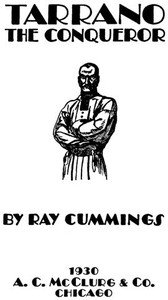
Tarrano the Conqueror by Ray Cummings
Authors: Cummings, Ray, 1887-1957
Okay, so picture this: it's the 25th century, and humanity has spread across Venus, Earth, and Mars in a fragile peace. Then, out of the frozen north of Venus, comes Tarrano. He's not your typical warlord with an army; he's a master strategist who uses psychology, ancient secrets, and sheer audacity to try and unite the three worlds under his rule. The story is told through the eyes of an ordinary man, Georg, who gets swept up in the chaos when Tarrano kidnaps the woman he loves. It's a race across the solar system—from the canals of Mars to the jungles of Venus—to stop a conqueror who might just be smarter than everyone else in the room. If you love classic sci-fi with a dash of planetary romance and a villain you can almost admire, you need to check this out. It's a forgotten gem that moves at a breakneck pace.