
eBooks
100 Books found- Featured

Paris by Émile Zola
Authors: Zola, Émile, 1840-1902
Hey, so I just finished Zola's 'Paris' and wow—this isn't your typical romantic postcard of the city. Picture this: a brilliant young priest named Pierre Froment is having a full-blown crisis of faith right in the middle of the bustling, modernizing Paris of the 1890s. He’s watching the Church struggle to stay relevant while society around him is being reshaped by science, industry, and a growing chasm between the rich and the desperate poor. The real mystery here isn't a whodunit—it's whether Pierre can find a new purpose, a new 'religion' to believe in, when the old one seems to be crumbling before his eyes. It’s a surprisingly tense, personal story set against the massive, noisy backdrop of a city on the cusp of the 20th century. If you've ever wondered how people hold onto hope when the world is changing too fast, this book grabs you by the collar and asks that question directly.
- Featured
Jeannot et Colin by Voltaire
Authors: Voltaire, 1694-1778
Ever wonder what happens when a lifelong friendship gets tested by sudden wealth and social climbing? That's the heart of Voltaire's sharp little story, 'Jeannot et Colin.' Imagine two country boys, thick as thieves, until one of them inherits a fortune and moves to Paris. Jeannot becomes obsessed with becoming a 'man of quality'—learning fancy dances, wearing ridiculous wigs, and forgetting his roots. Meanwhile, Colin stays put, working hard and staying true to himself. The real mystery isn't about a crime, but about character: can money and titles really buy happiness and worth? Voltaire, with his famously witty and critical eye, sets up a perfect social experiment. It’s a fast, funny, and surprisingly poignant look at vanity, friendship, and what we lose when we try to buy our way into a better life. If you've ever cringed at someone trying too hard to be something they're not, you'll get a kick out of this classic tale.
- Featured

The Olive Fairy Book by Andrew Lang and H. J. Ford
Authors:
Hey, have you ever wanted to escape into a world that feels both completely new and strangely familiar? That's what I found in 'The Olive Fairy Book.' It's not one story, but a whole collection of them, gathered from places like India, Persia, Turkey, and even Denmark. We're talking clever animals, brave princes and princesses, and magic that feels old as the hills. The main conflict? It changes with every tale! One minute you're following a hero trying to outwit a giant, the next you're rooting for a young woman using her wits to solve an impossible riddle. The real mystery is how these stories, from such different corners of the world, all speak to the same parts of us—the parts that love adventure, justice, and a touch of magic. It's like finding a treasure chest you didn't know you were looking for. If you're tired of the same old plots and want something that feels fresh and ancient at the same time, give this a try. It’s the perfect book to dip in and out of, and each story is a little surprise waiting to happen.
- Featured
The Viking Age. Volume 1 (of 2) by Paul B. Du Chaillu
Authors: Du Chaillu, Paul B. (Paul Belloni), 1835-1903
Hey, I just finished the first volume of 'The Viking Age' by Paul Du Chaillu, and it's not your typical dry history book. Imagine an explorer from the 1800s—who actually traveled through Scandinavia—sitting you down and telling you everything he learned about the Vikings. But here's the thing: he's writing in the late 1800s, and his ideas are a wild mix of groundbreaking research and the outdated beliefs of his time. The real conflict isn't just in the battles he describes; it's in the book itself. You're constantly asking: Is this a reliable fact, or is this just what people in the Victorian era *thought* about Vikings? It's a fascinating, frustrating, and totally unique look at how our understanding of history is built—and how it changes. It reads like an adventure, but it makes you think like a detective.
- Featured
Dada by Adolf Knoblauch
Authors: Knoblauch, Adolf, 1882-1951
Ever wonder what it was like to be an artist in the middle of a world gone mad? 'Dada' by Adolf Knoblauch is your backstage pass to the most gloriously weird art movement in history. It’s not a dry history lesson—it’s a wild ride through the smoke-filled cabarets of Zurich during World War I, where a bunch of poets, painters, and provocateurs decided the only sane response to a senseless war was to make nonsense art. The book follows Knoblauch’s own journey from a confused soldier to a key player in a movement that wanted to tear down every rule about what art could be. The real conflict isn’t on a battlefield; it’s in the mind. Can you create something meaningful by deliberately making something meaningless? Can laughter and absurdity be a weapon? If you’ve ever felt like the world doesn’t make sense, you’ll find a kindred spirit in these pages. It’s funny, shocking, and surprisingly profound.
- Featured
Les gens de bureau by Emile Gaboriau
Authors: Gaboriau, Emile, 1832-1873
Hey, have you ever read a mystery where the crime scene isn't a foggy London street, but a stuffy government office? That's 'Les Gens de Bureau' for you. Forget detectives in trench coats—this one follows a young, broke clerk named André who gets tangled in a scandal right from his first day. Someone's been embezzling funds, and all the evidence points to him. The real mystery isn't just 'whodunit,' but how he can possibly clear his name when the entire system seems designed to crush him. It's a page-turner that feels surprisingly modern, all about fighting a faceless bureaucracy. If you like puzzles and stories about the little guy, you'll fly through this.
- Featured
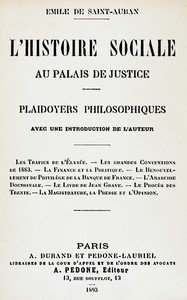
L'histoire sociale au Palais de justice. Plaidoyers philosophiques by Saint-Auban
Authors: Saint-Auban, Émile de, 1858-1947
Hey, I just finished this fascinating book that feels like a secret history of justice. Imagine a lawyer in late 1800s France who decides to use his courtroom speeches not just to defend his clients, but to put the entire social system on trial. That's Émile de Saint-Auban. The book collects his 'philosophical pleas'—actual arguments he made before judges. The central mystery isn't a whodunit, but a 'why-do-we-let-this-happen?' It's about a man using the rigid, formal stage of the Palais de Justice to ask dangerous questions about poverty, inequality, and the law's role in it all. It reads like watching someone try to bend a steel bar with words. Was he successful? Did he change any minds, or was he just a brilliant voice crying out in a marble hall? The tension comes from seeing one person's courage clash with the weight of tradition. If you like stories about rebels in unexpected places, this is a hidden gem.
- Featured

Vathek; An Arabian Tale by William Beckford
Authors: Beckford, William, 1760-1844
Okay, picture this: an ancient Arabian palace built by a power-hungry caliph who dabbles in dark magic. That's Vathek's world. He's not your typical hero—he's arrogant, curious to a fault, and willing to do anything to gain forbidden knowledge and supernatural power. The whole story kicks off when a mysterious, sinister stranger arrives with a deal too tempting to refuse. It's a wild, gothic ride through opulent halls and cursed landscapes, where every wish has a terrible price. If you like stories about ambition gone horribly wrong, with a lavish, almost dreamlike setting, you have to check this out. It's like a cautionary tale from another world, written with this intense, poetic flair that just pulls you in. Seriously, it's a weird and wonderful little classic.
- Featured

Travels in Central Asia by Ármin Vámbéry
Authors: Vámbéry, Ármin, 1832-1913
Ever wondered what it would be like to walk into a world completely closed to you? In the mid-1800s, a Hungarian scholar named Ármin Vámbéry did just that. He disguised himself as a wandering dervish, a holy man, to travel through the heart of Central Asia—a region forbidden to Europeans at the time. This isn't a dry history book; it's a real-life spy thriller. Vámbéry risked everything. If his true identity was discovered, he'd likely be killed. He traveled with caravans, faced bandits, and navigated the dangerous politics of rival khanates, all while secretly documenting everything he saw. The central mystery isn't about a crime, but about a man: can he pull off the greatest performance of his life and return to tell the tale? His journey is a raw, unfiltered look at a lost world, written by the man who risked his neck to see it. If you love true adventure stories that feel almost too wild to be true, this is your next read.