
Books by Barbara Laurent
100 Books found- Featured
Slave Narratives: A Folk History of Slavery in the United States from…
Authors: United States. Work Projects Administration
Hey, have you ever wondered what it was really like to hear directly from people who lived through slavery? Not from a historian or a novel, but in their own words? That's exactly what 'Slave Narratives' is. It’s not a single story with a plot, but a massive, raw collection of interviews with the last generation of formerly enslaved people, recorded in the 1930s. The main 'conflict' here is the brutal truth versus fading memory. These are real voices—sometimes hesitant, sometimes vivid—describing their childhoods, their work, their families torn apart, and their first moments of freedom. It’s not an easy read, but it’s a necessary one. It cuts through the textbook summaries and lets you sit with the actual human experience. It feels less like reading a book and more like being handed a precious, heartbreaking stack of letters from the past. If you want to understand American history from the ground up, start here.
- Featured
Los Caudillos de 1830 by Pío Baroja
Authors: Baroja, Pío, 1872-1956
Hey, if you ever wondered what the chaos after a civil war really feels like—not from a history textbook, but from the ground level—this is your book. Pío Baroja's 'Los Caudillos de 1830' drops you into the brutal, messy years following Spain's First Carlist War. It's not about kings and treaties; it's about the local strongmen, the 'caudillos,' who filled the power vacuum with their own rules. The story follows Martín Zalacaín, a man caught between these factions, trying to survive and maybe keep a shred of his own morality intact. The main tension isn't just who wins the fight, but what happens to ordinary people when the lines between right and wrong are drawn in blood and ambition. It's gritty, fast-paced, and feels astonishingly relevant. Think of it as a political thriller set in the 19th century, where every alliance is fragile and every friend could be tomorrow's enemy.
- Featured
Papeis Avulsos by Machado de Assis
Authors: Machado de Assis, 1839-1908
Okay, so you know how sometimes you meet someone who seems totally normal, but then they say one thing that makes you go, 'Wait, what?' and you realize their brain works on a completely different operating system? That's the feeling you get reading 'Papeis Avulsos' (which means 'Loose Papers' or 'Scattered Sheets'). It's not one big story, but a bunch of short pieces by Machado de Assis, Brazil's literary genius. Don't let the 19th-century date fool you—this feels weirdly modern. The main 'conflict' here isn't a sword fight or a love triangle. It's the quiet, hilarious, and sometimes unsettling battle between what people pretend to be and who they actually are. You'll meet a guy who gets a government job and immediately starts acting like a pompous windbag, a man obsessed with being seen as a serious intellectual, and other characters caught in their own silly, human traps. Machado watches them all with this dry, knowing smile. It's like he's sitting next to you, nudging your elbow and pointing out the absurdity of it all. If you're tired of straightforward plots and want something that picks apart society with a sharp, witty scalpel, this is your book.
- Featured

The Poems and Prose Poems of Charles Baudelaire by Charles Baudelaire
Authors: Baudelaire, Charles, 1821-1867
Hey, I just finished reading Baudelaire's complete poems and prose poems, and I need to talk about it. This isn't your typical poetry collection. Imagine the most beautiful, decadent, and sometimes shocking walk through 19th-century Paris you could take. The main thing here isn't a plot—it's a conflict happening inside one man's head. Baudelaire is constantly torn between two worlds: the divine beauty he desperately wants to reach and the ugly, sinful, modern city he's stuck in. He finds splendor in rot and grace in the gutter. He writes about love, death, wine, and wandering the streets with this intense, almost painful clarity. It’s like he’s trying to scrape beauty out of the dirt with his fingernails. If you’ve ever felt out of step with the world, or found something strangely lovely in a place you shouldn’t, you’ll get it. It’s a dark, brilliant, and utterly human mess of a book.
- Featured
Eco da Voz Portugueza por Terras de Santa Cruz by Antonio Feliciano de Castilho
Authors: Castilho, Antonio Feliciano de, 1800-1875
Ever wonder what it sounded like when Portuguese explorers first arrived in Brazil? That's the question at the heart of this fascinating 19th-century book. It's not a novel, but more like a linguistic detective story. The author, Castilho, was obsessed with a single idea: that the way people spoke Portuguese in Brazil held echoes—the 'eco' in the title—of the very first settlers. He believed you could hear history in an accent or a forgotten word. The book is his attempt to prove it, sifting through the way people talked in the 1800s to find traces of the 1500s. The real mystery isn't a crime, but a sound. Did those early voices really survive, preserved in everyday speech centuries later? Castilho makes his case, and it's a compelling invitation to listen to the past in a whole new way. If you love history, language, or just a good intellectual puzzle, this is a unique and rewarding read.
- Featured
Gulliver's Travels by Jonathan Swift
Authors: Swift, Jonathan, 1667-1745
Okay, imagine this: you wake up on a beach and you're tied down by hundreds of tiny ropes. Turns out, you're a giant in a land of people six inches tall. That's just the *first stop* for Lemuel Gulliver in this wild 18th-century adventure. 'Gulliver's Travels' isn't just a kids' story about little people and giants—it's a brutally funny, surprisingly sharp satire that holds up a mirror to human nature, politics, and society. Think of it as the original, more cynical 'Around the World in 80 Days.' Gulliver sails to four bizarre lands, each one weirder than the last, and through his eyes, author Jonathan Swift roasts everything from petty religious squabbles to the absurdity of war. It's a travel log from a genius with a major axe to grind, and reading it feels like uncovering a secret, hilarious critique of humanity that's still painfully accurate today. Trust me, you'll never look at politicians, scientists, or even yourself the same way again.
- Featured
The Story of Switzerland by Lina Hug and Richard Stead
Authors: Stead, Richard
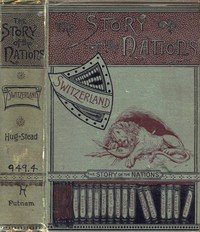
Hey, I just finished this book that completely changed how I see Switzerland. You know how we think of it as just chocolate, banks, and perfect mountains? This book showed me it's a country built on a wild, messy, and incredibly human story. It's not a dry history lesson—it's about how a bunch of stubborn mountain communities, caught between huge empires, somehow managed to create one of the most unique and stable countries in the world. The real mystery the book explores isn't about a person, but about an idea: how did 'Switzerland' even happen? How did these different groups, speaking different languages, decide to stick together instead of tearing each other apart? It answers that question by walking you through centuries of battles, alliances, and quiet moments of decision that feel surprisingly relevant today. If you've ever been curious about what's behind the postcard-perfect image, this is your backstage pass.
- Featured
Félicité: Étude sur la poésie de Marceline Desbordes-Valmore
Authors: Montesquiou-Fézensac, Robert, comte de, 1855-1921
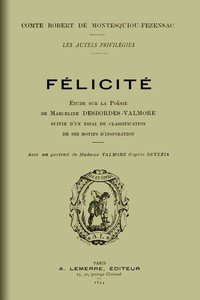
Okay, hear me out. I just finished this wild little book that’s part biography, part detective story, and part love letter to a forgotten poet. It’s called 'Félicité: Étude sur la poésie de Marceline Desbordes-Valmore.' The author, this 19th-century French count named Robert de Montesquiou, is basically obsessed with another poet, Marceline Desbordes-Valmore. She was a huge deal in her time—think Victor Hugo admired her—but she’s been largely forgotten. The whole book is Montesquiou trying to figure out why. Was it because she was a woman? Because her poetry was too emotional? Because life just isn’t fair? He’s digging through her heartbreakingly beautiful poems about love, loss, and survival, and building a case for her genius. It feels less like a dry academic study and more like watching a super-fan on a mission to restore someone’s rightful place in history. If you’ve ever felt like your favorite artist never got the credit they deserved, you’ll get this immediately.
- Featured
The Cow by Robert Louis Stevenson
Authors: Stevenson, Robert Louis, 1850-1894
Okay, so you know Robert Louis Stevenson for pirates and strange doctors, right? Forget all that for a minute. I just read this weird little story of his called 'The Cow,' and I need to talk about it. It's not an adventure tale at all—it's quiet, unsettling, and totally stuck with me. The whole thing hangs on this simple, bizarre question: why is a perfectly normal farmer so utterly, irrationally terrified of his own cow? It's not a wild beast; it's just a farm animal. But to this man, it's a monster. Stevenson takes this one strange fear and builds this incredible tension. You keep waiting for something to happen, for the cow to actually *do* something, while watching this poor man unravel. It's a masterclass in how to build dread out of nothing. If you like stories that get under your skin by making the ordinary feel terrifying, you have to check this out. It's short, but it packs a punch.